I’ve just come back from travelling across northern Argentina, moving between indigenous communities, nurseries, agroforestry plots, and long conversations with Alianza Wichi territorial team, technicians, and allies. After walking the land together, sharing meals, listening to elders, and watching young people work with their hands in the soil, I can say with even greater certainty what we already knew alongside the Indigenous communities we work with:
restoring native forests and rebuilding food sovereignty is not a dream. It is happening, now, through a growing network of communities that are choosing life over abandonment, knowledge over extraction, and regeneration over resignation.
What I witnessed on the ground
In the Gran Chaco, the word “forest” is never just about trees. It is water. It is medicine. It is culture. It is memory. It is the possibility of staying on one’s land with dignity.
Across our network of community nurseries, we are producing thousands of trees—and the nurseries have become far more than a technical solution. They are living classrooms, meeting points, and symbols of autonomy. We are recovering and multiplying native seeds and high ecological and cultural value species—guayacán, mistol, white carob (algarrobo blanco), urundel, lapacho, and many more. At the same time, communities are propagating fruit trees that strengthen household nutrition and local economies: mango, banana, achiote (urucú), papaya, avocado, pitanga, species that thrive when there is care, water management, and collective commitment.
These nurseries represent something deeper than production. They represent a shift: from dependency to capacity, from scarcity to planning, from being “the last in line” to being protagonists of a new landscape.

Agroforestry as a bridge between forest and future
The agroforestry systems we are building—always co-designed, always adapted to each community—are turning community spaces into sources of abundance and biodiversity. What moves me most is not only the harvest, but the human ecosystem forming around these plots.
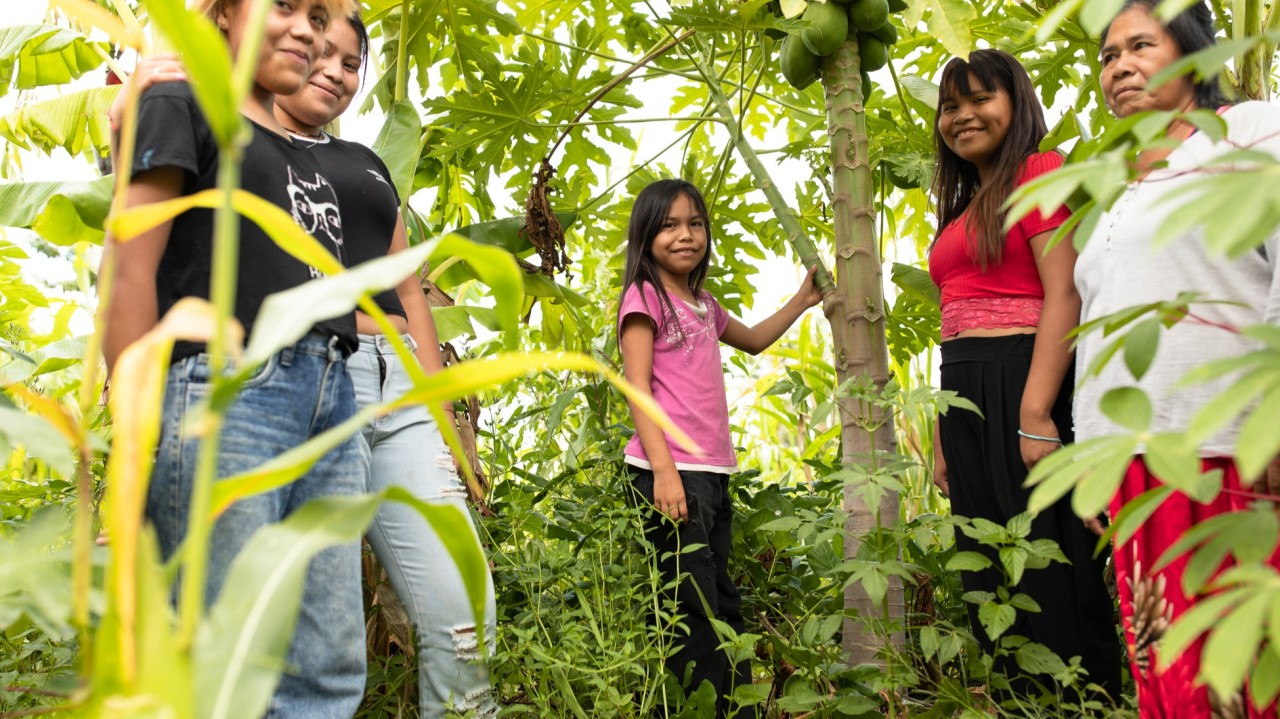
Women, young people, and even children work alongside Abel and Dalida, our experts in forest and agroforestry production, learning by doing, sharing responsibilities, and gradually taking ownership. And something beautiful is happening: Weenhayek, Wichí, Guaraní, Chorote youth and women are becoming Indigenous promoters and trainers, ready to travel across a vast territory and teach these methods to other communities that are asking for the same opportunity.
In a region where isolation is often used as a weapon—where vulnerability is structural and historical—this kind of peer-to-peer learning is revolutionary.
When the news travels faster than we do
One of the most powerful surprises of this trip was witnessing how quickly word spreads. People are arriving from other areas, men and women, coming not for aid, but for learning. They come to see these agroforestry systems with integrated gardens where, through deep care and intelligent design, the strength of the native forest is recreated in the same space that produces food.
In these plots, you find native and wild fruits alongside staples and garden crops: beans, cassava, maize, squash, potatoes, tomatoes, and yes, also bananas and avocados, woven together with an extraordinary diversity of medicinal plants: Lemon Verbena, rosemary, burrito, lavender, hopper plant and many others used daily by families.
These “edible forests,” together with the nurseries that feed them, have become models to replicate, systems that are already supplying new communities that want to join, share knowledge, and adapt the experience to their own territories and family needs.

A regional synergy that feels like a domino effect
There is something simply wonderful, almost humbling, about watching nature and culture recover together.
As the local forest ecosystem begins to return, so does the confidence of the people who belong to it. And when Indigenous knowledge meets experiences from Brazil and Bolivia, agrofloresta, permaculture, regenerative production, a synergy emerges that feels like a domino effect. The learning multiplies. The network expands. The horizon grows.
This is not “development” in the conventional sense. It is something more intelligent, more rooted, more alive: regeneration led by communities who never forgot how to read the land—only needed the chance to rebuild what was interrupted.
Biodiversity is already responding
Even in places where deforestation and pressure are relentless, life is answering back when given an opening.
We are witnessing the return, sometimes subtle, sometimes unmistakable, of birds, insects, reptiles, and mammals drawn to the richness of these restored spaces. Charatas, chuñas, toucans, and countless other species are finding food, shade, and refuge in what is being rebuilt. These landscapes are becoming small but powerful sanctuaries, nodes of resilience within a territory that is under immense threat.
And this matters beyond any one community.
Because the Gran Chaco is not a remote corner of the world. It is one of South America’s great ecosystems, a mosaic that connects the Yungas, the Chaco plains, wetlands and grasslands, carrying biodiversity, carbon, culture, and climate stability in its fabric. When it collapses, we all feel it. When it recovers, it offers a blueprint for hope.
The challenges are real, and enormous
None of this is romantic. The marginalisation is deep. The vulnerability is structural. Access to water, infrastructure, land security, and basic rights is often precarious. And without long-term allies, stable financing, and public policies that match the scale of the crisis, these initiatives remain fragile.

But what I saw, what we are living, proves that the path is right.
Today more than ever, we will keep moving forward with the certainty that regeneration is possible, and that cultural diversity is not a “heritage” to be displayed, it is a living intelligence essential for the future.
For cultural autonomy. For food sovereignty. For the climate crisis. For forests that can breathe again. For more Sanctuaries of Culture and Nature producing healthy, diverse food, rooted in territory, dignity, and community leadership.
An open invitation, a call to action
If you are reading this and you feel the weight of what is happening to our ecosystems, and the urgency of doing something real, this is an invitation:
Stand with Indigenous communities who are already regenerating the Gran Chaco. Help us scale what is working: community nurseries, agroforestry systems, water solutions, training for Indigenous promoters, and the expansion of a network that is becoming a living model of resilience.
Support can take many forms, funding, partnerships, technical collaboration, visibility, policy alignment, but it starts with a simple decision:
to back life.
We are ready. The communities are ready. The forest is responding.
Now we need more allies to walk this path with us.
Martin Kraft – martin@alianzawichi.org