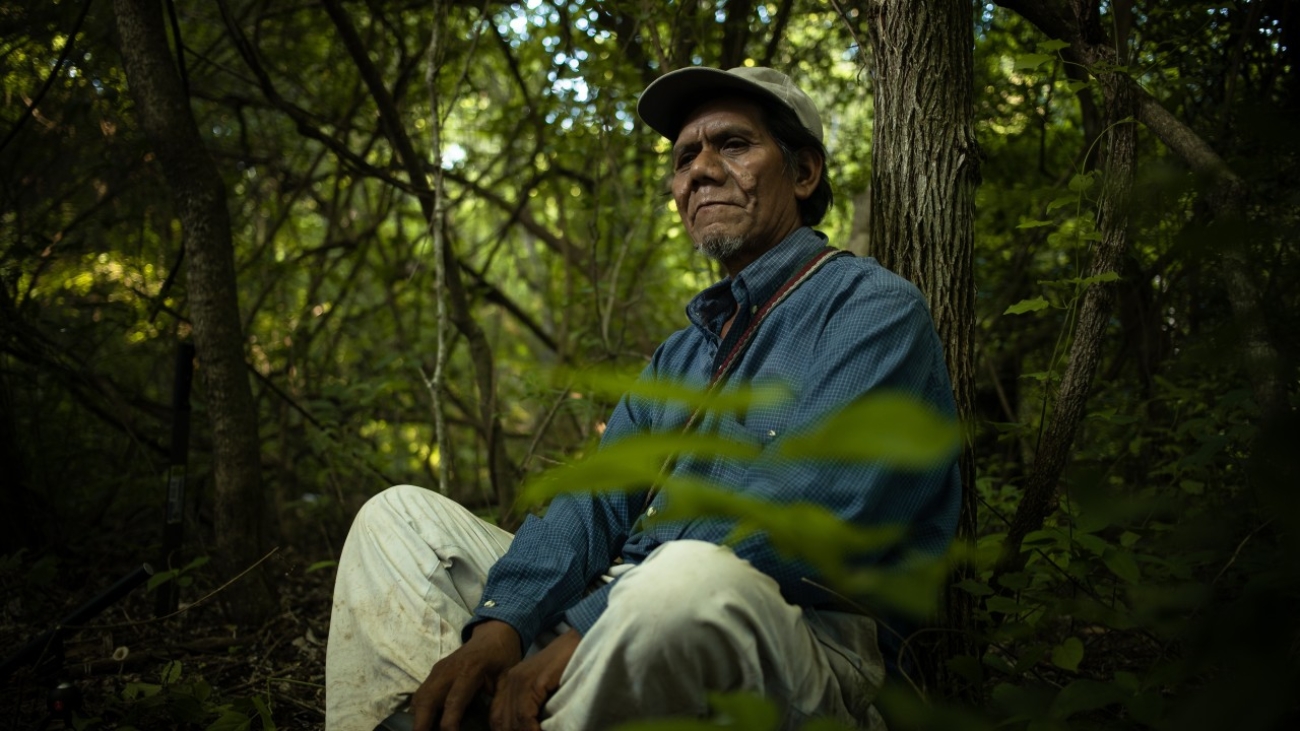
Nearly a decade ago, in the city of Tartagal, on the edge of Argentina’s Chaco region, I met Juayuk. I was meant to leave the next day, but accepted his invitation — unaware that this encounter would forever change the way I relate to the world.
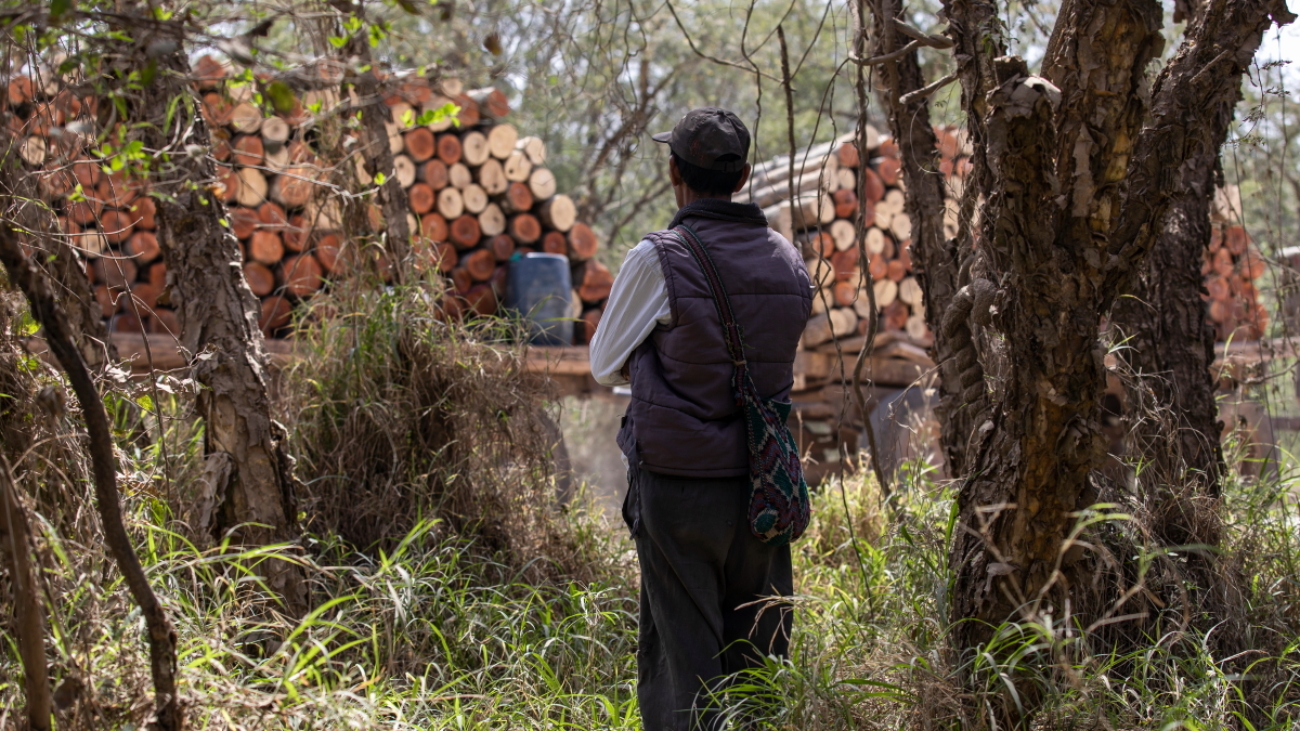
Juayuk barely spoke. In truth, he had spent years in near-complete silence. Not as a form of spiritual retreat, but due to abandonment. His people, the Wichí, live from and for the forest. But logging, the advancing agricultural frontier, and institutional neglect had devastated not only the trees, but the sacred bonds his community shared with the land.
“My brothers are gone… Those of us who remain no longer live from the forest as we once did. Only I still listen to the mothers of the trees,” he told me.
His community is small, secluded down a dirt road that becomes impassable with rain. It lies at a magical ecological junction — where the lush Yungas rainforest fades into the dry Chaco woodlands. This mosaic is home to century-old guayacanes, cedars, molles, algarrobos, and urundeles: a paradise for any botanist… or any logging truck.
Juayuk, at dawn, getting ready to share with me the messages from the forest.
Juayuk tried to protect the forest the way one protects an ageing mother. When chainsaws arrived, he confronted the workers with soft words, begging them to spare the “mothers” — the great seed-bearing trees that sustain the forest’s future. For a while, this fragile negotiation worked. But eventually, as money pressures mounted, even these sacred trees fell.
Still today, Juayuk enters the forest before dawn each morning. He moves like a bee, pollinating life. He says the forest is a choir: birds converse among themselves and with him; winds carry ancestral whispers; the trees sing messages through their roots. He listens to what most of us have forgotten — or chosen not to hear.
As an anthropologist, I confess that I didn’t understand him at first. I saw his way of speaking with the forest as metaphor — a poetic form of resistance. What a narrow, impoverished perspective mine was. From a Western scientific framework, anything unverifiable tends to be dismissed. It took time — and humility — to realise that I was in the presence of a system of knowledge as sophisticated as any ecological theory, expressed through song, silence, and sacred practice.
Juayuk does not separate spiritual practice from ecological knowledge, nor botany from philosophy, nor music from medicine. For him, knowledge is lived: it is danced, sung, planted. When trees are ready, the mothers offer him their seeds — and he places them in the soil with prayers and chants to awaken their strength. His method of reforestation differs profoundly from ours. For him, to plant is not to restore — it is to commune.
I’ve learned more from Juayuk than from many books. His ancestral wisdom, far from being a relic of the past, offers a necessary compass for our collective future. In a time of climate crisis and ecological collapse, perhaps the most radical thing we can do is pause — and listen. To the forest. To Juayuk.
The purpose of this short text is to highlight the importance of the vegetation, the forests of the Argentine Chaco and their biodiversity for the Wichí people. To this end, I present an overview of the role of native plants and ecosystems within this native culture. I will do so on the basis of the observations, results and conclusions I have obtained in the course of the research I have been carrying out for more than 15 years on Wichí ethnobiology, that is, on the relationships that this culture maintains with its environment, with the ecosystems and the beings and landscapes that shape them. These relationships include how they conceive, name, classify and use plants, animals and other beings, the different landscapes or spaces of their habitat, and natural phenomena; and why they do it as they do (both symbolically and pragmatically).
In the Gran Chaco, the region that constitutes the territory of the Wichís in northern Argentina is characterised by its native forests which, despite the region’s lack of water, constitutes an oasis, home to countless plants, animals and other living beings of unique biodiversity. Centuries ago, the indigenous people knew how to adapt to the marked seasonality and inclemency of an area that presents serious obstacles to subsistence, and it is here that for centuries and centuries their daily lives have been lived, created and recreated in accordance with the natural environment, and vice versa.
Plants and vegetation as a whole occupy a central place in Wichí culture and society. They are present everywhere in the different areas of their daily life. In food, for example, there are around 100 species of native plants registered as food, the vast majority of them wild. Fruits, tubers, flowers, roots, resin and herbs form the basis of the diet of this traditional gathering people. Combined with fish, meat and fats from wild animals, eggs and honey, they provided a varied diet despite the scarcity of food during the winter, the harshest time of the year. Many changes have been taking place in the diet since the arrival of the settlers and in line with the associated socio-environmental changes. Today, refined flour and sugar, sugary industrial drinks, yerba mate, fats and salt abound in daily life. The lack of free territory to hunt, fish and gather, massive deforestation due to agribusiness and other extractive activities, the loss of associated biodiversity, the shift from seasonal nomadism to sedentary (or semi-sedentary) lifestyles, the scarcity of economic resources to access quality commercial food, among other factors, have led to the current situation, where little food and nutritional impoverishment are commonplace. Thus, many forest foods have fallen into disuse and are even unknown (at least the details of their preparation and/or use) by the younger generations in many Wichí communities and families. This is true for foods that were very common in the past, such as ohnak (‘sacha sandia’ in local Spanish, Capparis salicifolia), änhyuk (‘poroto del monte’, Cynophalla retusa), newok (‘mandioca del monte’, Marsdenia castilloni), or aloja de algarroba (the fermented drink par excellence in Wichí culture), based on the fruits of jwa’ayukw (‘algarrobo blanco’, white carob, Prosopis alba), as well as, and even more so, for unusual foods that were mentioned by only a few people, such as the flowers of atsukw (‘bola verde’, Anisocapparis speciosa) or the seeds of tsemlhäkw (‘yuchán’, Ceiba chodatii). However, all these foods are interesting forest products for a varied diet of the local people and have a great potential for their projection and commercialisation for local benefits. Despite this, there is a lack of scientific information on their nutritional composition, details of their ecology, among others.
In medicine, plants and the forest also play an important role. In the Wichí conception there is a distinction between minor ailments and real illnesses; the latter are life-threatening and must be treated not only physically but also spiritually, so that the husek (soul, goodwill) is repositioned within the body and balance is recovered. Herbs and other medicinal species have always been used to treat minor ailments or disorders, symptoms of illnesses and to help the work of shamans, healers and biomedicine to heal the illnesses. Nowadays, the number of species used for medicinal purposes has apparently increased compared to the past due to a number of socio-environmental factors, such as the Wichís’ thirst for knowledge and experimentation, the exchange of information among Wichís, Creole and other neighbours, the lack of access to careful and quality care in the state medical system, the decline of shamans (who have always been persecuted for their practices contrary to the precepts of Christian religions and hegemonic science), the appearance of new health problems and, as the Wichís themselves affirm, the worsening of the general state of health, which goes hand in hand with nutritional impoverishment and changes in diet. Phytotherapy is nowadays mostly used for prevalent diseases, such as skin disorders, digestive and respiratory problems, fever and female cycle issues. In a small portion of the Wichí territory alone, in the centre of the Chaco of Salta province, I have been able to record the use of 115 wild plant species for more than 400 medicinal applications to treat 68 ailments and/or symptoms.
We could go on at length and explain the role of plants in other aspects of the past and present life of the Wichís. The plants of the forests and other native environments are raw materials for building houses and decorating them; for extracting textile fibres and making clothes, utensils and other objects; for dyeing textiles, such as face paints; for magic or spells; for curing and feeding animals; for repelling insects; among others. But plants are not only raw materials or elements with utilitarian importance. Their cultural importance also lies, of course, in the symbolic and metaphysical field. According to the Wichís, it is not only animals, humans, fungi and plants that inhabit and pass through the world. Metaphysical beings or “spirits” live in different parts of the cosmos and also have specific links to plants and forests. Many plants of outstanding cultural importance, such as the chitsaj (‘cháguar’, Bromelia hieronymi; food plant and central to textile art, from which fibres are extracted) or the aforementioned white carob tree (a plant with countless associated uses and symbolisms), as well as entire forests and other areas, are cared for or used by some of these beings, so that certain actions by humans (Wichís and non-Wichís) of carelessness, excessive extraction, among others, lead to undesired socio-environmental consequences. Certain stories explain and highlight particular relationships between humans, animals, spaces and certain plants from mythical times. Moreover, it is in certain places in these ecosystems of the Wichí territory that transcendent events that are preserved in the memory of the people took place: these events are reflected in countless toponyms (place names) that tell of their location and characteristics.
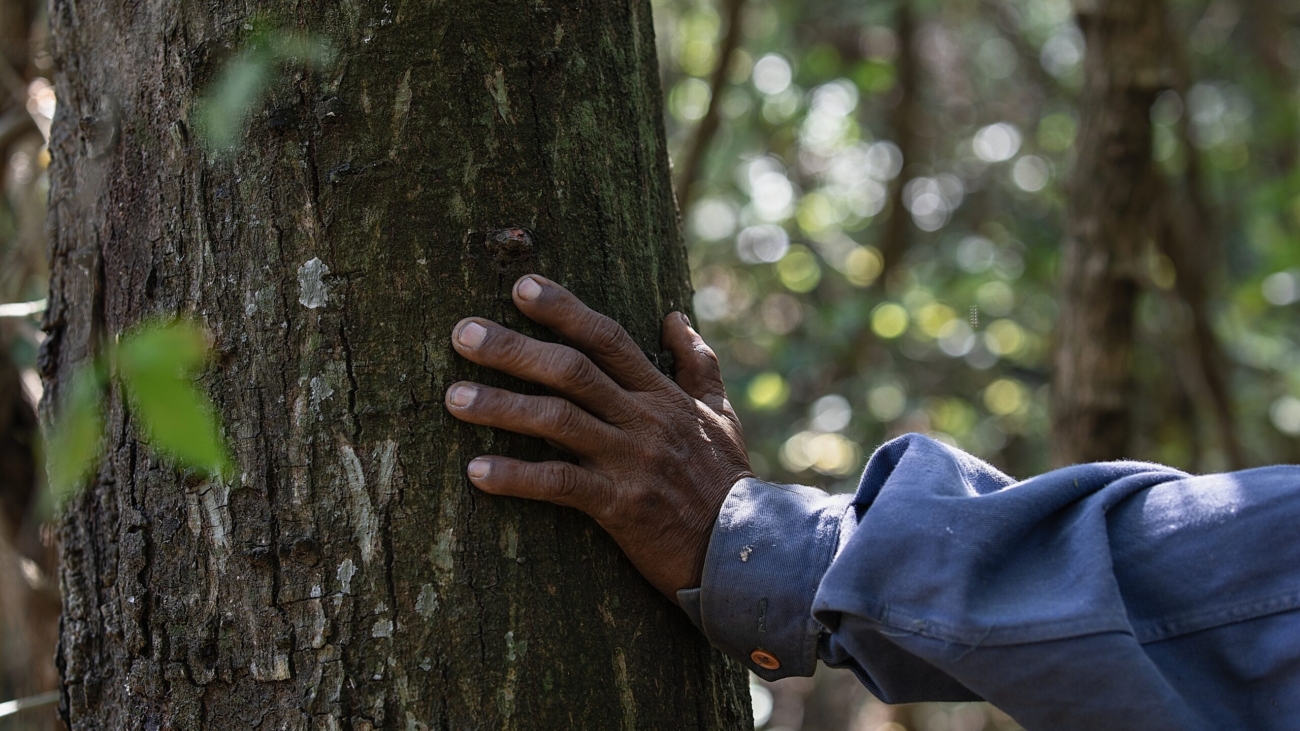
We were deep into the forest when Juayuk stopped walking. The midday light filtered through the canopy, painting the undergrowth in slow-moving gold. He looked up, silent, then down at the roots beneath our feet.
“Try to take a photo where I’m not what matters,” he said, half-smiling. “Let the forest be the one you see.”
I took some time to reflect on his request and lowered my camera before shooting.
“Try to take a photo where I’m not what matters,” he said, half-smiling. “Let the forest be the one you see.”
I had been walking with Juayuk — a Wichí elder and spiritual ecologist from the Gran Chaco — for several weeks. My role was to document, to listen, and perhaps, if I was careful, to begin understanding. I came as an ethnographer and filmmaker, but more and more, I was shedding those words. In the forest, they felt inadequate.
What I was witnessing was not simply reforestation. It was a philosophy of regeneration, rooted in memory, fungi, fire, and reverence.
Beneath the Silence
What lies beneath the forest floor is not soil in the ordinary sense. It is a living archive — of relationships, of language, of grief, and of hope. Juayuk calls this world the deep memory of the trees.
Modern science has begun, cautiously, to echo him. A recent study published in Current Biology revealed that between 79% and 83% of ectomycorrhizal fungi (ECM) — the fungal networks that sustain trees — remain undescribed by science. These underground webs:
Feed the roots with nitrogen and phosphorus
Carry sugars, water, and chemical signals
Help forests resist drought, fire, and disease
And store 2.5 gigatonnes of carbon per year
And yet, in most conservation plans, they are still invisible. Unnamed. Unprotected.
Forests, it turns out, do not end where the eye does.
The Breath of Life
We came to a fallen tree — not long dead. Juayuk knelt beside it and brushed away the bark. There, emerging from a crack in the trunk, was a considerable protuberance, coppery orangish fungus. He held it carefully, like one would hold a newborn bird. It fell apart at a mere brush of the hand.
“This is wahan’cheiaj,” he whispered. “The breath of life.”
“This is
It is both metaphor and organism — a sacred fungus that emerges from the dead and makes possible the living. Juayuk uses it to reconnect what has been cut: he joins the still-living roots of a felled tree with a seed, sometimes from another species. The wahan’cheiaj acts as bridge, glue, alchemy, a protector.
Over time, the roots of the felled tree and the new sprout fuse. They grow. Sometimes they become something new.
We are currently documenting a remarkable hybrid — between a Yuchán (Ceiba chodatii) and a Cedro (Cedrela odorata). It is over 50 years old. Its trunk and flower defy taxonomic certainty. You feel, standing before it, that you are in the presence of something impossible — and entirely real.
The Bombs That Birth Forests
Days later, he shared with me another mystery. Beneath a towering Guayacán (Caesalpinia paraguariensis), we began gathering soil, ash, fungi, seeds, and dry wood. Juayuk formed a mound — a mother bomb, he called it.
Inside, he lit a small fire. Then he sealed the earth around it, leaving tiny breathing holes. Over the next 80 days, the fire would smoulder slowly, warming the mound from within.
Juayuk singing next to this “Mother Bomb” of life.
This was not destruction. This was incubation.
“Like a womb,” he said. “Dark, warm, full of life.”
Inside, microorganisms, rhizomes, and fungal spores would multiply. The earth would become black and rich in carbon, much like the terra preta of the Amazon. Once ready, he would open the mound, spread the living soil in a circle, and wait for the rains.
And then — without planting a single tree — the forest would begin to rise.
“The trees walk by themselves,” Juayuk says. “We only remind them how.”
Youth, Memory, and the Unseen Emergency
What struck me most was not the technique — extraordinary as it was — but the urgency. Juayuk worries that younger Wichí are losing their connection to this knowledge. Decades of cultural erasure and systemic denial of the value of Indigenous ways of knowing and relating to living beings have led many to believe that their grandparents’ wisdom is irrelevant — unscientific, even. A long process of acculturation and internalised dismissal has silenced not only traditions, but entire ways of perceiving the world.
And yet, these very ways might hold answers to the ecological crisis we all face.
At Alianza Wichi, we are working to protect this ancestral wisdom, not just as cultural heritage, but as a living tool for planetary regeneration. With the guidance of scientists like Dr María Eugenia Suárez (CONICET) and her team of ethnobiologists, we are studying these techniques not to extract or simplify them, but to honour and share them.
How do we bridge the language of science with the language of spirit? How do we listen — deeply — across worlds?
Toward Sanctuaries of Culture and Nature
What we envision now is a network of Sanctuaries: places where ancestral knowledge, native ecosystems, and community-led restoration coexist.
These will not be parks or museums — but living landscapes where:
Elders passing on ancestral knowledge to younger generations, preserving culture through living practice.
Scientists working alongside Indigenous experts, in mutual respect and co-creation of knowledge.
Forest regeneration tied to food sovereignty, restoring ecosystems while feeding communities.
A living school of ancestral wisdom, open to the world, rooted in practice, spirit, and soil.
A model for global replication, offering place-based solutions that can inspire regenerative action worldwide.
It is a vision born not only of urgency, but of trust and reciprocity towards nature and cultural diversity.
The Film, the Forest, the Future
The film weaves together themes of spiritual ecology, hybrid trees, fungal intelligence, mycorrhizal memory, pyrolysis, and the art of minimal intervention. It reveals that forests do not need to be controlled or replanted from above — they can return from within, if we learn to listen, to trust, and to act in reciprocity.
But this is more than a story of regeneration. It is a call to protect what remains and to recover what was silenced — to save these native forests from exploitation and collapse, and to ensure that the ancestral knowledge that sustains them does not vanish with the last elders who carry it.
At the heart of this journey is my bond with Juayuk — one that began in curiosity but grew into something deeper: a friendship rooted in admiration, humility, and learning. He is not a subject of my study, nor a figure in need of saving. Quite the opposite.
He is my teacher. My guide. In many ways, my saviour — reminding me of what it means to belong to a living world.
He carries a vision that can help all of us reimagine our relationship with the Earth — not as masters, but as kin.
What Juayuk embodies is not just a technique, but a worldview — one that sees trees as relational beings, not resources; fungi as bridges, not by-products. This way of knowing deserves to be recognised, protected, and shared. It is time to declare it for what it is: an Intangible Cultural Heritage of Humanity.
This film, and the voices within it, seek to spark impact and awareness — not only to inform, but to transform: to invite a shift in how we relate to the natural world. To remember that we are not above nature, but woven into it — through soil, breath, memory and root.